Guides
How we manage altitude, medical care, and risk on private corporate Kilimanjaro expeditions, written for the people who sign off.
By Janosch Amstutz · White Mountain Camp
For HR, legal, insurance and the sponsoring executive
It is a fair question, and it deserves a careful answer rather than a confident one. Kilimanjaro is a high mountain, and altitude carries inherent risk. The honest position is that the risk is real, it is well understood, and it can be managed to a high standard, which is exactly what a private corporate expedition is built to do.
This guide is written for the stakeholders whose job is to be sceptical: the HR lead responsible for the wellbeing of employees, the legal team weighing duty of care, the insurance contact who needs the right cover in place, and the executive sponsoring the trip. It explains how our private corporate expedition manages altitude, medical care, and the unexpected, and what documentation we provide so you can complete your own review with confidence. We do not ask you to take any of this on trust; we ask you to request our detailed medical and safety briefing and to scrutinise it.
Altitude and acclimatisation
Most of the risk on Kilimanjaro is altitude-related, and the single most effective control is how slowly and intelligently a group ascends. That is why we run the seven-day Lemosho Route. Lemosho is chosen deliberately for its gradual acclimatisation profile, which gives the body more time to adapt to thinning air, and, in turn, a high summit-success rate. A longer, gentler ascent is not a luxury here; it is a safety decision.
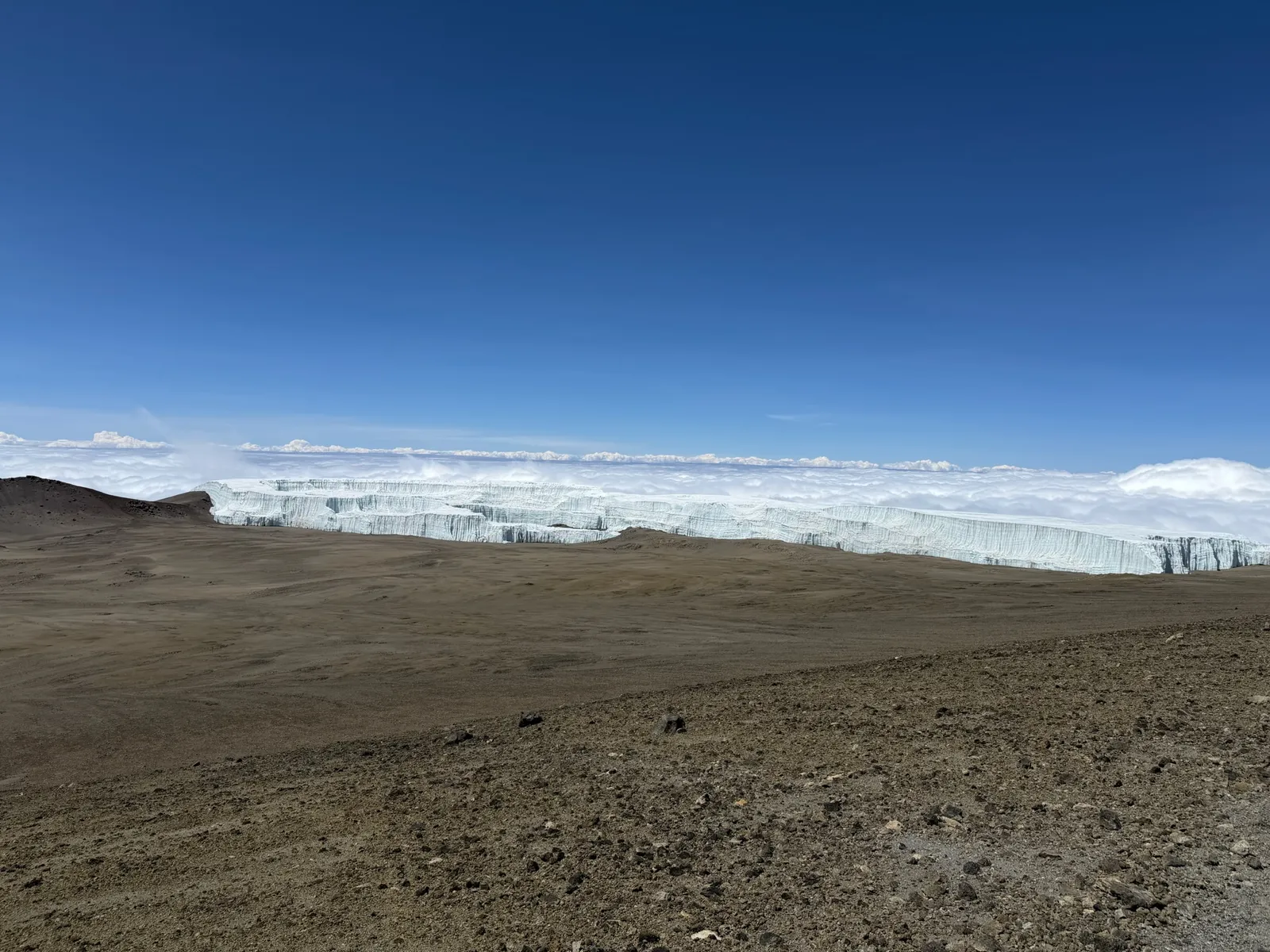
The itinerary applies long-established "climb high, sleep low" principles. On one of the key days, the group ascends to Lava Tower at 4,640 metres and then descends to sleep lower, at Barranco at 3,960 metres. Exposing the body to altitude during the day and then resting at a lower elevation is one of the most reliable ways to acclimatise, and it is built into the structure of the trek rather than left to chance. The summit itself, Uhuru Peak at 5,895 metres, is approached only after the body has had days to prepare.
No route eliminates altitude sickness entirely. What a well-designed profile does is reduce the likelihood of serious illness and make milder symptoms easier to catch and manage early, which is where daily medical oversight comes in.
On-mountain medical care
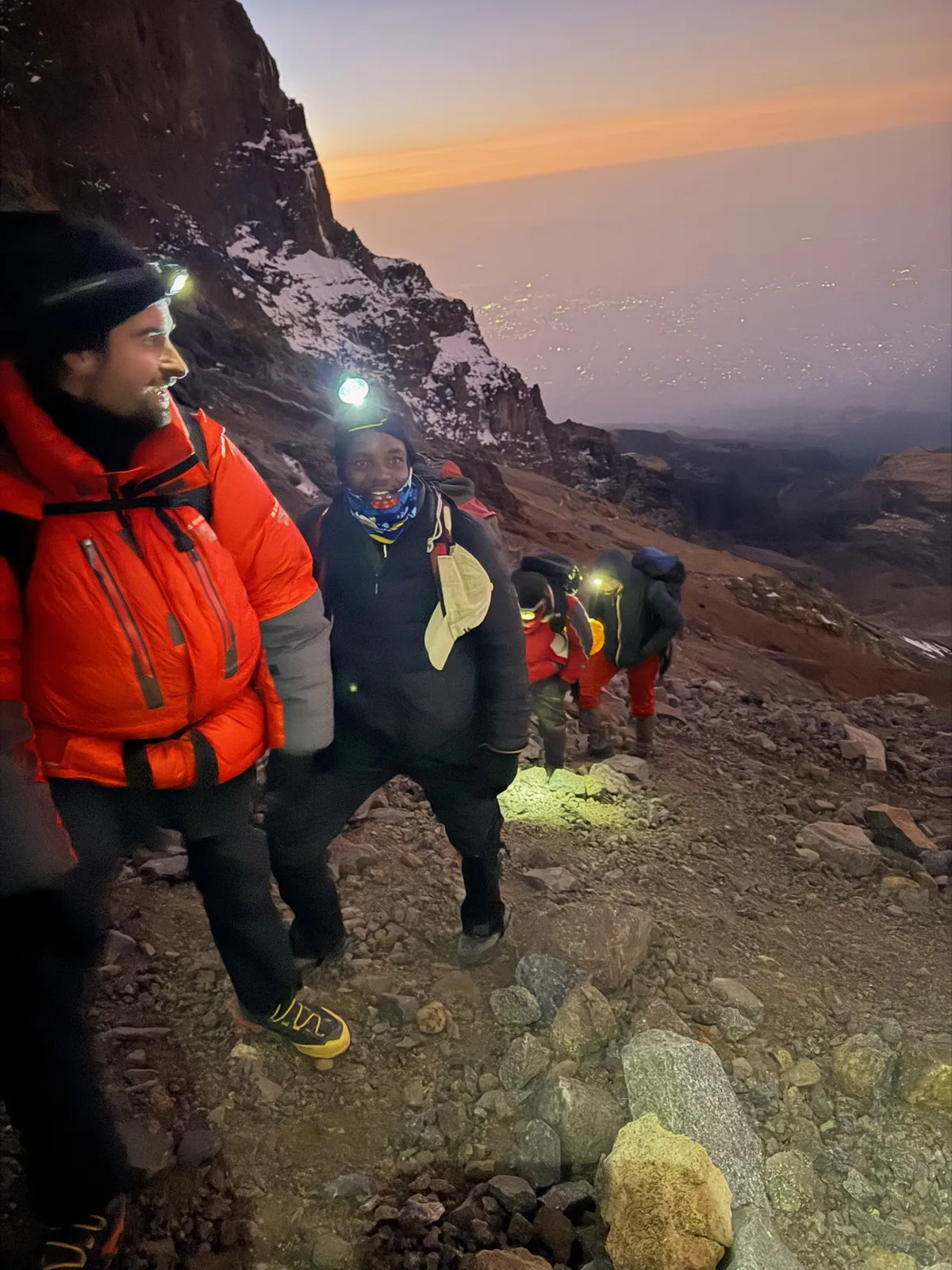
Every expedition runs with a dedicated on-mountain doctor available around the clock and daily medical checkups for every participant. This is the difference between hoping people are coping and actually knowing how each person is. Daily monitoring allows early signs of altitude sickness, or any other issue, to be identified and addressed before they become serious, and it gives every participant a clear, private channel to raise how they feel.
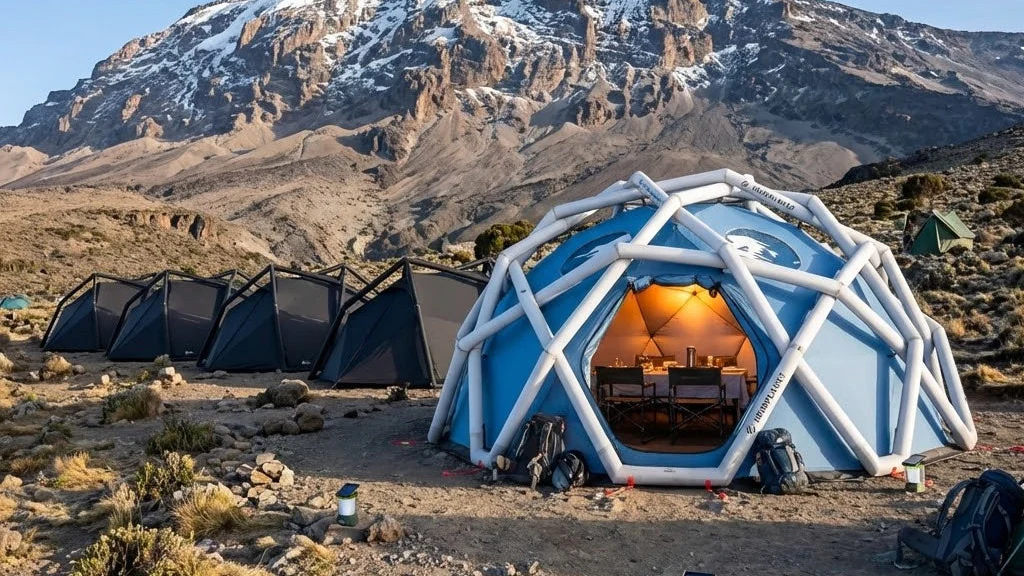
Around the medical care sits an environment designed to keep people well. Warm, dry luxury private camps with real beds mean participants actually rest and recover overnight, rather than arriving at summit day already depleted. A private chef ensures proper nutrition and consistent hydration, both of which materially affect how the body handles altitude. Private guiding means the pace is set for your group alone. These are comfort features on the surface; underneath, they are part of the risk-management system.
These are comfort features on the surface; underneath, they are part of the risk-management system.
Screening, prevention and response
Risk management starts at enquiry, not at the trailhead. Every participant completes pre-trip medical screening and is asked to confirm their fitness to take part with their own doctor, disclosing relevant conditions and medications. For mixed-ability teams this matters: it lets us understand the group honestly and plan pacing and support around the people in it, rather than assuming a uniform level of fitness that rarely exists in a real leadership team.
On the mountain, prevention is mostly about discipline, sensible pace, hydration, nutrition, rest, and listening to the body. Where symptoms of altitude sickness do appear, the response follows a simple, well-established hierarchy: monitor, manage, and if needed, lose altitude. The most effective treatment for altitude sickness is descent, and our itinerary and staffing are arranged so that descending a participant is always an available option rather than a crisis. Decisions about whether someone continues are made on health grounds, in consultation with the doctor, never on summit ambition.
Evacuation and descent
Responsible expedition practice treats evacuation not as a dramatic last resort but as a planned-for part of operating on a mountain. Our approach follows established descent-first principles: the great majority of altitude-related problems resolve as a participant moves to lower elevation, so getting someone down safely is the primary response, supported by the on-mountain doctor's assessment.
Where a situation requires evacuation beyond descent on foot, recognised emergency procedures are followed to move the person to appropriate medical care. We deliberately keep this framing general rather than promising specific assets or response times, because conditions on a mountain vary and over-precise claims would be misleading. What we commit to is a clear protocol, qualified medical judgement on the ground, and a participant's personal travel insurance standing behind any evacuation and onward medical care, which is why that insurance is required.
Insurance
Comprehensive personal travel insurance is a requirement for every participant, and it is deliberately excluded from the expedition price so that each person holds cover suited to them. We recommend insurance that explicitly covers high-altitude trekking to the elevation of this expedition, emergency medical treatment, and emergency evacuation and repatriation. Standard leisure-travel policies frequently exclude trekking above a certain altitude, so the detail matters.
For corporate risk stakeholders, we suggest confirming a short checklist for each participant before departure:
We do not name or recommend specific insurers; the right choice depends on each participant's circumstances and your organisation's existing arrangements.
Inclusion
A summit is a demanding goal, and not everyone in a leadership team will want, or be advised, to reach it. That should never mean someone is left out of the experience. Because the expedition is private and bespoke, we can design partial-participation and non-climbing options around your team: joining the lower stages, supporting from a comfortable base, or taking part in the shared experience without committing to the full ascent.
This flexibility is also a duty-of-care safeguard. It means participation can be matched to each person's health and fitness honestly, rather than pressuring anyone to attempt more than is sensible. We work through these options with you during planning so that the whole group is included appropriately and no individual feels they must take a risk they would rather not.
Duty-of-care documentation
We expect to be reviewed, and we make that straightforward.
On enquiry, we provide a detailed medical and safety briefing for your duty-of-care stakeholders. It sets out our acclimatisation approach and itinerary, the role of the on-mountain doctor and daily health checks, the pre-trip medical screening every participant completes, our general descent and evacuation principles, the insurance we require, and the partial-participation options available. It is written so that HR, legal, insurance, and the sponsoring executive can each find what they need to complete a review. We encourage you to request it early in your planning, the right time to scrutinise duty of care is before a single date is held.
Questions risk stakeholders ask
Some degree of altitude effect is common at Kilimanjaro's elevations and is part of the climb for many people; serious illness is far less common when ascent is gradual and properly monitored. We use the Lemosho Route specifically for its gentle acclimatisation profile and apply climb-high, sleep-low principles, for example ascending to Lava Tower at 4,640m before descending to sleep at Barranco at 3,960m. A dedicated on-mountain doctor performs daily health checks so symptoms are caught early and managed before they escalate.
No prior mountaineering experience is required. The expedition suits motivated people of ordinary good health who prepare sensibly; the gradual Lemosho profile and unhurried pacing are designed to accommodate mixed-ability teams rather than only the fittest members. We ask every participant to complete pre-trip medical screening and to confirm fitness with their own doctor, and we tailor pacing so the group moves at a sustainable rate.
No one is locked into the summit. If a participant chooses to stop, or our doctor advises it, the expedition is structured so that an individual can rest, descend, or remain at a lower camp with appropriate support while the rest of the group continues. Where descent is needed for health reasons, it follows established descent-first principles, with the priority always being the wellbeing of the individual rather than the summit.
Yes. Personal travel insurance is required of every participant and is not included in the price. We recommend comprehensive cover that explicitly includes high-altitude trekking to the elevation of the expedition, emergency medical treatment, and emergency evacuation and repatriation. Corporate risk stakeholders should confirm that each participant's policy covers these elements, that the maximum trekking altitude is adequate, and how the policy interacts with any corporate travel or duty-of-care cover already held.
On enquiry we provide a detailed medical and safety briefing covering our acclimatisation approach, the role of the on-mountain doctor and daily health checks, pre-trip medical screening requirements, our general descent and evacuation principles, insurance requirements, and partial-participation options. It is intended to give HR, legal, insurance, and the sponsoring executive what they need for duty-of-care review. We encourage stakeholders to request this briefing early in their planning.
Altitude carries inherent risk, and we are honest about that. For people of ordinary good health who prepare and acclimatise properly, Kilimanjaro is regularly climbed by a wide range of ages and fitness levels. The combination of the gradual Lemosho profile, daily medical monitoring, an on-mountain doctor, warm dry private camps, and proper nutrition and hydration is designed precisely to support a mixed group safely, with non-climbing and partial-participation options so no one is excluded.
Key takeaways
Complete your review with confidence
Tell us about your team and your duty-of-care requirements, and we will send the detailed medical, safety, and risk-management briefing your stakeholders need. You can also read more about our private corporate expedition.
Explore Corporate Retreats