Guides
Timeline, fitness, logistics and cost, the practical guide for the person organising it. If you have been asked to organise a Kilimanjaro climb for your leadership team, this walks through what planning an executive expedition actually involves, so you can scope it with confidence before you enquire.
By Janosch Amstutz · White Mountain Camp
If you have been asked to organise a Kilimanjaro climb for your leadership team, you are likely weighing a lot at once: dates that work across senior diaries, a mixed-ability group, duty-of-care sign-off, and a budget you will need to defend. This guide walks through what planning an executive expedition actually involves, lead time, fitness, the seven-day route, the logistics that are handled for you, and how the cost is framed.
A summit attempt is a genuine shared challenge, which is precisely why it works as a leadership offsite. Done well, almost everything on the ground is taken off your desk; what remains is the internal coordination only you can drive. Read this as the brief you would want before the first conversation.
Lead time and when to go
The slowest part of planning a corporate Kilimanjaro climb is rarely the mountain. It is the internal work: holding dates across busy executive calendars, securing duty-of-care sign-off from HR, legal and insurance, giving participants time to build fitness, and letting people arrange their own flights and visas. None of that should be rushed, so the practical answer to "how long to plan a leadership expedition" is several months, and earlier is better for a senior group.
White Mountain Camp runs expeditions in October 2026, with further dates in February and July 2027. Private corporate expeditions are arranged on request, which means the departure can be built around your organisation's calendar rather than squeezed into a fixed timetable, and bespoke planning rewards an early start: the sooner the date is held, the more the itinerary, pacing and leadership framing can be shaped around your team.
A useful sequence is to lock a target window first, confirm the core group, then run fitness preparation and duty-of-care approval in parallel over the months that follow. Personal logistics can be finalised later, but the date and the group should be settled early.
Fitness for a mixed-ability team
The most common worry from a champion organising this is fitness: a leadership team is rarely uniform, and not everyone is a regular hiker. The reassuring reality is that Kilimanjaro is a high-altitude trek, not a technical climb, there is no rope work, no ice axes, no scrambling that requires mountaineering skill. What it asks for is endurance and a sensible head for altitude.
Expect days of roughly 6 to 8 hours on foot, covering around 8 to 15 kilometres, at a deliberately slow pace designed to help the body acclimatise. The Lemosho Route is chosen precisely because its gradual profile gives mixed-ability groups the best chance of summiting safely, and it carries a high summit-success rate. The discipline is patience, not speed; the phrase guides use across Tanzania, pole pole, slowly slowly, is the whole strategy.
For preparation, a few months of regular cardiovascular training and hill or stair walking is the sensible baseline for most participants. The point of planning early is to give the least-prepared member of the team time to build up. During planning we discuss each participant's fitness individually, and pacing can be designed so the whole group moves together rather than the strongest setting the tempo. A dedicated on-mountain doctor performs daily checkups and is available around the clock, which removes much of the anxiety that mixed fitness can create.
The discipline is patience, not speed; the phrase guides use across Tanzania, pole pole, slowly slowly, is the whole strategy.
The seven-day Lemosho route
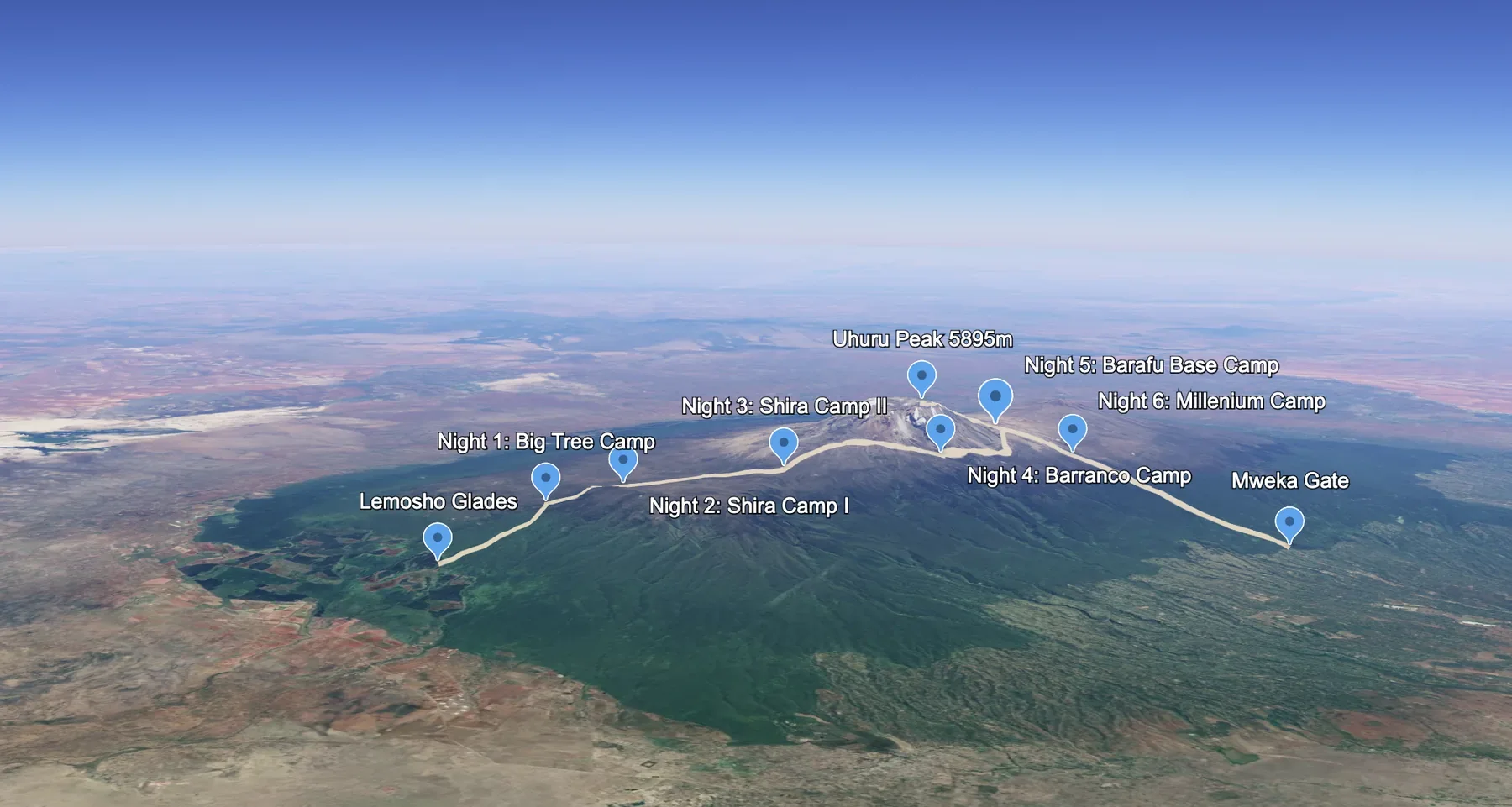
The route is built around acclimatisation, and it doubles neatly as an arc of team development, early days that build rhythm and trust, a deliberate plateau that tests patience, and a summit night that asks everything of the group at once. At a high level:
| Stage | What happens | Team lens |
|---|---|---|
| Arrival | Fly into Kilimanjaro International (JRO), transfer to the five-star lodge, gear check. | Settle in, brief the team, set the tone. |
| Day 1 | Lemosho Gate to Big Tree Camp, through rainforest. | Find a shared rhythm; the easiest day. |
| Day 2 | Climb to Shira Camp I as the forest opens to moorland. | Conversation deepens; the office recedes. |
| Day 3 | Shira Camp II, an acclimatisation day on the high plateau. | Patience under no urgency; trust forms. |
| Day 4 | Traverse via Lava Tower (4,640m) down to Barranco Camp (3,960m). | Climb high, sleep low; resilience tested. |
| Day 5 | The Barranco Wall, then on to Barafu Camp (4,640m). | A real obstacle, cleared together. |
| Day 6 | Summit night to Stella Point (5,739m), then Uhuru Peak (5,895m / 19,341ft); descend to Millennium Camp. | The shared peak the team carries home. |
| Day 7 | Descend to Mweka Gate; certificates at the lodge. | Recognition and reflection. |
| Departure | Safari options, or transfer to the airport. | Decompress before re-entry. |
The summit night is the moment everyone remembers, but it is the slow middle, the acclimatisation day and the Lava Tower traverse, that quietly does the team-building work. For a fuller account of why this format works for executive groups, see our corporate retreats page, or the October 2026 Lemosho expedition.
Logistics and what is handled for you
The logistics divide cleanly into two parts: what each participant arranges personally, and what is handled for you on arrival. Knowing the split keeps your planning tidy.
Participants fly into Kilimanjaro International Airport (JRO) in Tanzania. From the moment they land, White Mountain Camp takes over: airport pick-up, transfer to the five-star lodge, gear check, the expedition itself, and the transfer back at the end. Most nationalities require a Tanzanian visa, which travellers arrange themselves in advance, alongside personal travel insurance. International flights are booked individually too, useful, since a senior team often departs from different cities.
Everything on the mountain is taken care of, which is the point of a private expedition: all national park fees and permits, the private camp with HEIMPLANET Arctic expedition tents, elevated trail beds with linens and Swiss down duvets, a private camp chef cooking western and local cuisine, hot showers, private gender-separated camp facilities, private guiding throughout, and a dedicated on-mountain doctor available 24/7. As the organiser, your job is to coordinate the people; the ground operation is ours.
Cost framing and what is included
Private corporate expeditions are premium and priced on enquiry, because each is built around one organisation. To frame a budget before you enquire, the public seven-day expedition is a useful reference: approximately $10,000 to 12,000 per person, $12,000 for single occupancy and $10,000 sharing a double or twin. Payment terms on the public expedition are fifty per cent on booking to secure places, with the balance due sixty days before departure.
The figure is more inclusive than it first appears, which matters when you present it. To make the comparison clean for whoever signs off, here is what sits inside and outside the price:
| Included | Not included |
|---|---|
| All transfers and airport pick-up / drop-off | International flights |
| National park fees and permits | Tanzanian visas |
| All meals, tents and equipment on the mountain | Personal travel insurance |
| Luxury lodge on half board, one night either side | Gratuities for guides and porters |
When you present the number internally, the honest framing is that this is an all-in ground cost rather than a headline rate with extras bolted on later. Build in flights from each participant's city, visa fees, insurance and a gratuities budget, and you have a defensible total. For a private corporate expedition, we quote to your group size, objectives and dates directly.
Putting the plan together
Key takeaways
Questions planners ask
Allow several months. The work that takes time is internal, securing dates in busy executive calendars, duty-of-care sign-off from HR, legal and insurance, individual fitness preparation, and personal logistics such as flights and visas. We recommend beginning the conversation well ahead of your intended departure so nothing is rushed.
Expeditions run in October 2026, with further dates in February and July 2027. Private corporate expeditions are scheduled on request around your organisation's calendar, so the date can be built around your team rather than a fixed timetable.
No prior mountaineering experience is required. Kilimanjaro is a high-altitude trek rather than a technical climb, and the seven-day Lemosho Route is chosen for its gradual acclimatisation profile and high summit-success rate, which suits mixed-ability groups. Expect days of roughly 6 to 8 hours and 8 to 15 kilometres. A few months of regular cardio and hill walking is the sensible baseline, and we discuss each participant's fitness during planning.
Participants fly into Kilimanjaro International Airport (JRO) in Tanzania, where we handle airport pick-up and transfer to the five-star lodge. Most nationalities require a Tanzanian visa, which travellers arrange themselves in advance, though a visa can also generally be issued on arrival at JRO for a fee (travellers should check). International flights, visas and personal travel insurance are not included; everything on the ground, transfers, park fees and permits, camps, meals, equipment and guiding, is handled for you.
Private corporate expeditions are premium and priced on enquiry, because each is bespoke. As an indicative basis, the public seven-day expedition runs approximately $10,000 to 12,000 per person, $12,000 single occupancy and $10,000 double or twin, inclusive of all transfers, national park fees and permits, meals, tents and equipment on the mountain, airport pick-up and drop-off, and a luxury lodge on half board one night either side. Flights, visas, personal travel insurance and gratuities are excluded.
For the public expedition, fifty per cent is due on booking to secure places, with the balance due sixty days before departure. Private corporate expeditions are quoted to your group, objectives and dates, with terms confirmed during planning.
Begin the conversation
Tell us about your team, your goals and your dates, and we will help you plan a private expedition around them, and answer the duty-of-care and budget questions before you take it internally. See our corporate retreats overview, or get in touch.
Explore Corporate Retreats